
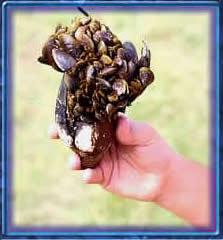
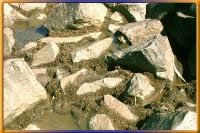
Strips with the settlement of gold mussels on the stones of the seaside Bagliardi beach, Berisso, Argentina, shore of the Río de la Plata, where his presence was cited for the first time in America. Density in the strips approximately 80,000 ind.m2.
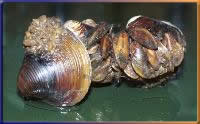
Heleobia piscium (d'Orbigny), Chilina fluminea (Maton), and Gundlachia concentrica (d'Orbigny). After the introduction of the invading bivalve, the presence of Ch. fluminea and G. concentrica is accidental.
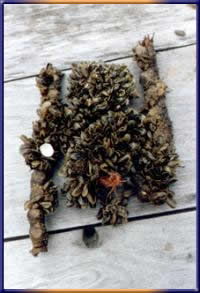
Another example of the impact on the local mollusk fauna is the settling of the golden mussel on native bivalves (naiads) and on another invading bivalve, Corbicula fluminea.
This kind of impact on benthic fauna is similar to that caused
by Dreissena polymorpha on roots of marshy plants native bivalves in the Northern
Hemisphere.
Another kind of
impact is observed at Guaíba Basin (Brazil), where the golden mussel
prevents the normal development of marsh plants like rushes.
The presence of the golden mussel also alters the trophic chains of
the environment. For instance, the "boga" (Leporinus obtusidens)
in the Río de la Plata changed its diet opting for the golden mussel
as its main food.
(1) MARTIN, S. & G.DARRIGRAN. 1994. Limnoperna fortunei (Dunker, 1857) en el Balneario Bagliardi, Río de la Plata. Alteración en la composición de la malacofauna litoral. Tankay, 1:164-166.
(2) DARRIGRAN,G.; S.M. MARTIN; B GULLO & L. ARMENDARIZ. 1998. Macroinvertebrados associated to the byssus of Limnoperna fortunei (Dunker, 1857) (Pelecipoda, Mytilidae). Río de la Plata, Argentina. Hydrobiología, 367:223-230. Bélgica
For
more information contact
us by e-mail:
invasion@fcnym.unlp.edu.ar
gdarrigran@hotmail.com
gdarrigran@malacología.com.ar