PREVENTING SPREADING

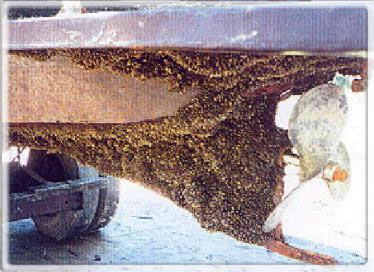
Sport boat in a highway of Brazil.
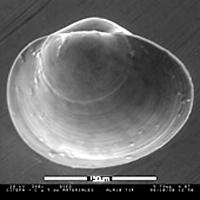
L. fotunei larvae. Last state of planctonic phase .
There
is no quick economically and environmentally sustainable way of getting
rid of the golden mussel. It causes considerable damage in water intakes
and pipes (macrofouling) as well as substantial
damage to tourism and nautical sports, as already happened at dos Pombas
beach, Guaíba lake, Porto Alegre, Rio Grande do Sul, Brazil. On boats,
it causes problems in refrigeration systems.
Another difficulty, which doesn't need many comments, is having a layer of mussels covering the boats.
As time goes by, the golden mussel will spread and increase its distribution to the rest of South America's freshwater bodies. Now is the time to act to reduce the spread and the damage it can cause. This way, researchers will have time to optimize sustainable prevention and control methods.
As time goes by, the golden mussel will spread and increase its distribution to the rest of South America's freshwater bodies. Now is the time to act to reduce the spread and the damage it can cause. This way, researchers will have time to optimize sustainable prevention and control methods.
The
countercurrent advance of this species (at about 240 km per year) is done
by anthropocoria (taken by man); stuck to the hull or by ships, both by
water and by ground (when vessels, nets or trailers are
taken by road to other bodies of water).
Avoiding an uncontrolled growth of it's spread, as well as it's growth on ships, will prevent later investments to keep hulls clean.
Avoiding an uncontrolled growth of it's spread, as well as it's growth on ships, will prevent later investments to keep hulls clean.
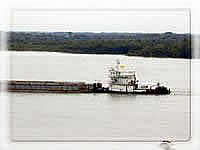
Raft on the Paraná
River that transports oil, cereals, etc.
Raft on the River Paraná, commonly carrying oil, cereals, etc.; the boats are the vectors that carries this species upstream by the Plata Basin (3).

STEPS TO PREVENT OR SLOW DOWN THE SPREADING OF THE GOLDEN MUSSEL:
-
Report the presence of the golden mussel to the Facultad de Ciencias Naturales y Museo de la Universidad Nacional de La Plata
Tel.: 54 221 425 7744e-mail:
invasion@fcnym.unlp.edu.ar | gdarrigran@hotmail.com | gdarrigran@malacología.com.ar
-
Always clean your entire vessel (boat, barge, sailboat, etc.) before taking it from an area suspected of being infested or polluted by this mussel to other areas.
-
Wash the hull and trailer with chlorine (500 cc in 10 liters of water). NEVER USE CHLORINE NEAR ANY BODY OF WATER AS YOU CAN ADVERSELY AFFECT WATER LIFE.
-
Use also high-pressure water or scrap the surface with a brush or spatula.
-
On hot, dry weather leaving the boat outside the water for 6 or 7 days(1). (exposed to air). The mussels will die some of the falling off while the rest will have to be scrapped off. Put the mussels in a garbage container o throw them far from water bodies or drainage.
-
NEVER use water from rivers or streams to carry live bait. NEVER transfer water from one water environment to another, as the larvae of the golden mussel are microscopic, and could be carried unintentionally from one water body to another.
-
Rinse bilges and other pumping systems, refrigeration, bailing pumps, etc. with chlorine solution or with a nonoxidinzing chemicals (2).
-
IF YOU ARE ALREADY ON DRY LAND and your boat or equipment has the possibility of having water from any water body (and thus, or potentially having golden mussels) make sure you clean it and throw the water on dry land, far away of water bodies.
At the Facultad de Ciencias
Naturales y Museo (UNLP), La Plata, Argentina, we are working
on a full guide for boatsmen, commercial fishers, divers, and
others, on how to safely transport live bait or equipment between
different systems and water bodies. |
(2) DARRIGRAN , G.; D. COLAUTTI & M. MAROÑAS. (2007) A potential biocide for control of the golden mussel, Limnoperna fortunei. Journal of Freshwater Ecology. 22(2):359-360.
(3) DARRIGRAN, G. & N. ARCARÍA (2011) Las invasiones biológicas en la costa Argentina y en la Cuenca del Plata. 179-192. En: Rubén Álvaro López - Silvia Cristina Marcomini (Eds.) “PROBLEMÁTICA DE LOS AMBIENTES COSTEROS. Sur de Brasil, Uruguay y Argentina”. UNESCO. Editorial Croquis
For
more information contact
us by e-mail:
invasion@fcnym.unlp.edu.ar
gdarrigran@hotmail.com
gdarrigran@malacología.com.ar